10–15 Days to Iran Deal—or Chaos? Oil Markets Brace, AGs Arm Up, Prince Andrew in Custody
Trump’s Board of Peace Ultimatum Sends Risk Premiums Higher Amid U.S. Legal Defenses and High-Profile UK Probe

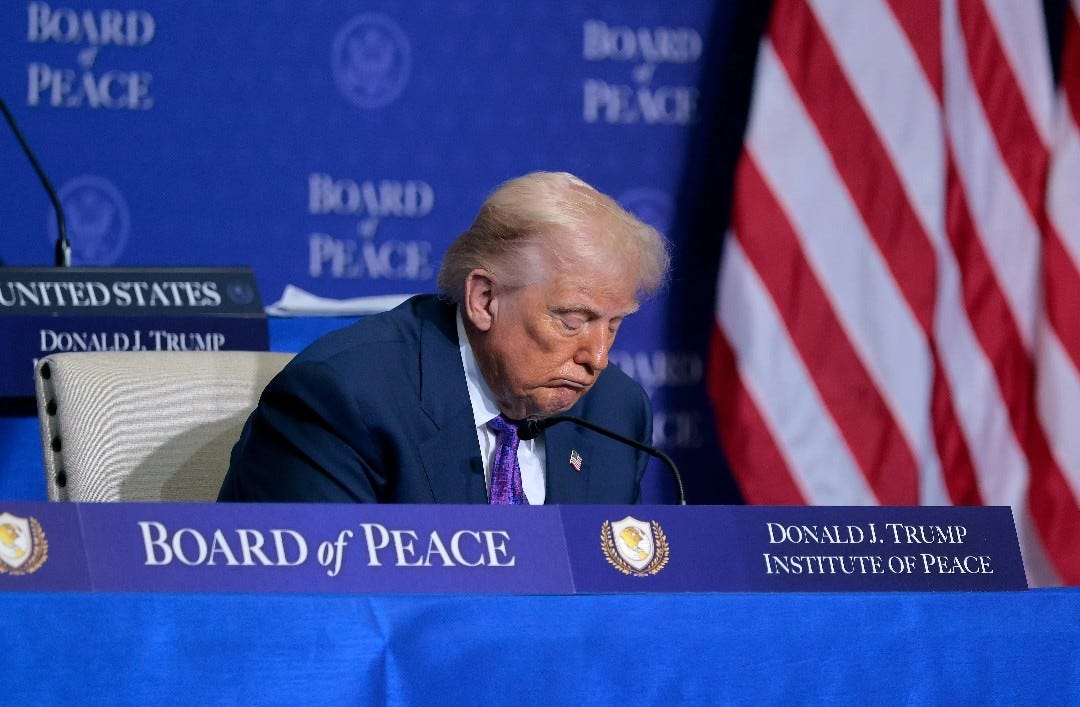
State attorneys general are building robust defenses against potential federal overreach, a former senior royal now faces criminal custody over Epstein-linked allegations, and escalating U.S.-Iran tensions are injecting immediate volatility into global oil markets. These threads—domestic institutional resilience, elite accountability, and international brinkmanship—highlight how interconnected threats can rapidly impact portfolios, inflation expectations, and energy sector positioning.
Adding sharp urgency today, President Trump—speaking at the inaugural Board of Peace meeting—issued a direct warning to Iran: “We’re either going to get a deal or it’s going to be unfortunate for them.” He set a 10-to-15-day window for Tehran to reach a nuclear agreement, stating, “I would think that would be enough time.” Paired with visible carrier movements in the Atlantic and Arabian Sea, this deadline is already lifting risk premiums and reminding investors how quickly geopolitical flashpoints can translate into higher gasoline prices, supply-chain pressure, and sector rotation opportunities.
Domestic
Attorneys General Unite Against Trump Era 2.0: A powerful coalition of state attorneys general—including New York’s Letitia James, Arizona’s Kris Mayes, and leaders from Delaware, Virginia, Colorado, Minnesota, Michigan, and Rhode Island—demonstrated deep solidarity at a recent San Francisco conference. Describing themselves as “constitutional warriors,” they stressed authentic collaboration to safeguard the rule of law and secure federal funding flows to states of all political colors. With a clear historical sense of duty, they committed to defeating Trump’s anticipated playbook, building directly on successes from 2020.
Tabletop Exercises for Doomsday Scenarios: The group runs regular simulations of extreme executive actions: invoking the Insurrection Act, seizing voting equipment, attempting to cancel elections, or manipulating mail-in ballots through Postal Service interference. Coordinated by Washington State’s AG team under Nick Brown, these quarterly drills produce pre-drafted legal filings, rapid-response teams, and “go-bags” ready for immediate court action—already proving effective against a weakened Department of Justice.
DOJ’s Talent Drain and Judicial Backlash: Participants highlighted the DOJ’s profound depletion: Trump lacks the personnel to fill roughly 7,000 vacancies with ideologically aligned figures, with perhaps only a handful of fringe attorneys available. Federal judges—initially surprised by early-term lawlessness—are adopting aggressive new tools, such as ordering the DOJ to produce violation spreadsheets (e.g., 96 ICE contempts in Minnesota federal courts in January alone). This judicial skepticism, shared by grand juries and the broader public, has stripped away any default presumption of federal credibility.
Habeas Corpus Violations Skyrocket: In New Jersey, under interim U.S. Attorney leadership navigating constitutional appointment questions, the DOJ acknowledged 56 habeas corpus violations across 547 cases since December. This wave stems from high-volume enforcement operations overwhelming an exhausted department—contrasting sharply with the roughly 500–600 executive-order challenges filed in Trump’s first term.
International
Prince Andrew’s Arrest Shocks UK Royals: On his 66th birthday, Andrew Mountbatten-Windsor (formerly Prince Andrew) was arrested by Thames Valley Police on suspicion of misconduct in public office tied to Jeffrey Epstein connections. Searches were conducted at properties in Berkshire and Norfolk, marking the first modern-era criminal arrest of a senior royal. He remains in custody and denies all wrongdoing.
Epstein Files Reveal Trade Envoy Abuses: During his 2001–2011 tenure as UK trade envoy, Andrew is alleged to have forwarded sensitive official materials—including Asian trip itineraries, post-visit reports, and Afghanistan-related commercial briefings on gold and uranium—to Epstein. These documents, surfaced through U.S. Justice Department releases, raise serious questions about misuse of public office for private benefit, breaching strict confidentiality rules designed to advance British commercial interests.
Potential for Broader Charges Looms: While the current suspicion centers on misconduct in public office (maximum penalty: life imprisonment), the arrest opens the door to examining allegations of sexual exploitation within Epstein’s network. Precedents such as the 2015 conviction of Bishop Peter Ball for similar abuses of position suggest prosecutors could pursue additional lines if evidence emerges of personal gratification obtained through official authority.
Police Procedures and Legal Uncertainties: Andrew may be detained up to 96 hours without charge (subject to senior approval and magistrate review), during which officers continue searching controlled properties and analyzing seized devices. The offense itself is widely regarded as vague; reform legislation is pending in Parliament, yet it remains a powerful instrument. Authorities have emphasized the case is “active,” cautioning against publications that risk contempt of court.
Royal Mystique Shattered: The dawn raid and custody strip away layers of traditional protection. With King Charles having already removed Andrew’s titles, the episode underscores growing vulnerability for elite institutions when long-standing associations collide with criminal scrutiny.
Iran
U.S.-Iran Tensions Escalate with Carrier Deployments: The nuclear-powered USS Gerald R. Ford is transiting the Atlantic (recently positioned off Morocco, heading toward the Strait of Gibraltar and Mediterranean), with estimates placing it days from potential operational range near Iran. It will join the USS Abraham Lincoln Carrier Strike Group already stationed in the Arabian Sea off Oman. This force posture aligns with Trump’s intensified pressure for a nuclear accord (decision window potentially closing in ~10 days) and recalls Desert Storm’s six-carrier requirement for operations against a major regional power.
Tactical Challenges: Scale and Escalation Risks: Current deployments fall short of what a serious campaign against Iran would demand—likely six carriers for sustained air and sea dominance. Bomber overflights carry high risk of shoot-downs well beyond rescue helicopter range, potentially necessitating ground insertion to recover crews and thereby escalating from air operations to broader land conflict.
Strategic Deterrents: Iran’s Size and Global Players: Iran’s vast geography and 90-million-strong population create formidable logistical barriers to any prolonged military effort—making limited strikes far riskier than quick resolutions. Escalation would almost certainly pull in major external actors, particularly China as Tehran’s principal economic lifeline, turning a bilateral dispute into a multi-front crisis.
China’s Potential Role in a Middle East Crisis: China absorbs more than 80% of Iran’s seaborne oil exports (recent averages ~1.13–1.38 million barrels per day despite sanctions and steep discounts). In a conflict scenario, Beijing could pivot to alternative suppliers or compete aggressively in global markets, but any closure of the Strait of Hormuz would severely threaten its Gulf-dependent energy security.
Oil Market Implications Drive the Calculus: The underlying dynamic appears heavily economic: elevating prices toward $80–90 per barrel would significantly improve U.S. shale margins and enable profitable reactivation of shut-in wells. WTI has already climbed on risk premiums (settling ~$66.43–66.73 today, up more than 2% amid the buildup and inventory dynamics), with analysts forecasting potential spikes to $90–100+ should Iranian supply or Gulf transit routes be disrupted—translating directly to higher inflation readings, elevated U.S. pump prices, and portfolio pressure across sectors.
As we close this dispatch, the convergence is unmistakable: domestic legal fortifications, high-profile accountability abroad, and a ticking geopolitical clock with direct energy-market consequences. No individual or institution appears untouchable, yet the pace of events demands constant vigilance—and smart positioning. Diversification, energy-exposure monitoring, and scenario planning remain essential tools in this environment.
What’s your view on these developments—and the oil angle in particular? Drop a comment.
Zelenskyy says he’s ready for substantial compromises. What do you think China has offered him?
https://www.foxnews.com/politics/china-pledges-aid-ukraine-us-officials-warn-beijing-quietly-fueling-russias-war