A Vague Compromise: US Proposal for a "Special Economic Zone" in Donetsk Raises More Questions Than Answers
Amid emerging cracks in administration power and deepening domestic turbulence, Washington pushes a hazy territorial deal that risks echoing historical appeasement failures

As the Trump administration faces mounting signs of internal divisions, health speculation, institutional pushback, accountability deficits, and emerging cracks in its power base at home—while aggressively pursuing foreign policies abroad—the proposed Ukraine settlement underscores growing vulnerabilities in U.S. leadership and diplomatic credibility.
Domestic
Epstein Estate Photos Released by House Democrats — On December 12, Democrats on the House Oversight Committee released selected images from over 95,000 photos subpoenaed from Jeffrey Epstein’s estate, depicting President Donald Trump, former President Bill Clinton, Steve Bannon, Bill Gates, Woody Allen, and others in social settings. The timed releases, ahead of a DOJ deadline for broader files, have intensified partisan scrutiny and debates over transparency.
Context of Associations in Released Images — The photographs reflect Epstein’s known 1990s-2000s connections to prominent figures in New York and Palm Beach circles. Trump and Epstein were acquaintances during that period; no new evidence from the releases indicates wrongdoing beyond documented past social ties. Trump has repeatedly distanced himself, stating he banned Epstein from Mar-a-Lago.
Cultural Norms Regarding Personal Photographs — It is commonplace in the US for individuals to keep or display photos of friends, celebrities, business contacts, or event souvenirs in homes, regardless of gender, without implying deeper personal relationships.
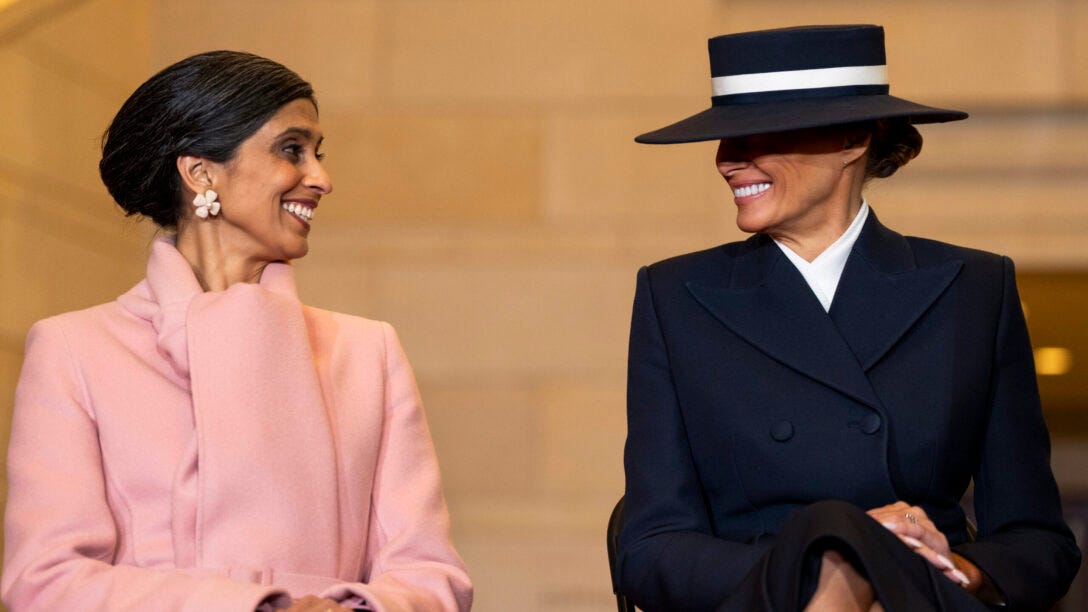
Succession Speculation — Reports suggest that if Vice President JD Vance is unable to assume greater responsibilities, his wife Usha could step in to support or even take on certain roles; if not, President Trump has indicated he could directly handle them instead.
Adm. Alvin Holsey Retires from U.S. Southern Command — On December 12, Navy Adm. Alvin Holsey officially retired after one year leading U.S. Southern Command, amid scrutiny over the Trump administration’s strikes on alleged drug-trafficking vessels in the Caribbean and Latin America. Holsey described the decision as personal during briefings to Armed Services Committee leaders, though Sen. Jack Reed noted lingering unanswered questions about timing and circumstances.
King Charles Announces Reduced Cancer Treatment — In a December 12 video message for Stand Up to Cancer, King Charles III shared positive news that his cancer treatment schedule can be reduced in the new year, thanks to “early diagnosis, effective intervention and adherence to ‘doctor’s orders’,” marking a milestone in his recovery while emphasizing the importance of early screening.
Emerging Cracks in Administration Power
Marjorie Taylor Greene’s Break from MAGA — Rep. Marjorie Taylor Greene has distanced herself from the “Make America Great Again” (MAGA) label, declaring she is strictly “America First.” This shift, amid her criticisms of Trump’s policies (e.g., foreign interventions and H-1B visas), has led to public feuds, with Trump revoking endorsements and calling her a “traitor.” Critics see her pivot as tied to far-right narratives and funding efforts to sustain MAGA-style politics despite perceived waning influence.
Trump’s Statement on “Good People Getting Hurt” — President Trump recently stated, “Good people are going to get hurt,” interpreted by some as self-referential amid ongoing legal pressures, investigations, and political setbacks.
Concerns Over Trump’s Health and Command — At age 79, growing concerns about the Commander-in-Chief’s health include reports of dementia-like symptoms, physical decline, slurred speech, confusion, gaunt appearance, and recurring dark bruises on his hands. Press Secretary Karoline Leavitt (December 11, 2025) attributed the bruises to excessive handshaking and a daily low-dose aspirin regimen, framing it as evidence of vigor—though skeptics link it to his July 2025 chronic venous insufficiency diagnosis. Some tie perceived decline to strategies benefiting his family through political or financial protections.
Could Trump Suspend Elections Amid Crisis? — With escalating U.S.-Venezuela tensions—including military buildups, rejected ultimatums to Maduro, and recent tanker seizures—questions arise about whether Trump could suspend elections if facing genuine war threats. Historical precedent (elections held during the Civil War and WWII) and lack of legal mechanism suggest no; the Supreme Court is unlikely to endorse halting free and fair elections.
Setbacks in Retribution and Gerrymandering Efforts — A Virginia federal grand jury rejected—for the second time in a week (December 11, 2025)—Trump administration attempts to indict NY AG Letitia James on mortgage fraud charges, thwarting revenge against political foes and exposing DOJ limits. Separately, Indiana Republicans defied intense pressure (including threats to withhold federal funds and primaries) by rejecting mid-decade gerrymandering that would add GOP seats (December 11, 2025), potentially leading to fairer 2026 midterms.
Kristi Noem and Deportation Controversies — In a December 11, 2025, hearing, Reps. Delia Ramirez and Seth Magaziner confronted DHS Secretary Kristi Noem over deportations affecting U.S. citizens and veterans. Noem denied deporting veterans but was challenged via Zoom by Sae Joon Park, a combat veteran and Purple Heart recipient who self-deported to South Korea after a removal order, fueling accusations of ethical and legal violations.
FBI’s Focus on Antifa vs. Actual Threats — In a December 11, 2025, hearing, Rep. Bennie Thompson pressed FBI officials on Antifa as a “terrorist organization” (per Trump’s designation). Officials admitted it’s an ideology, not a structured entity—no headquarters, member counts, or clear organization—likened to a boogeyman. Recent incidents more often tie to far-right/MAGA elements, raising questions over resource misallocation and deflection.
Broader Lack of Accountability — This pattern—lying, evading responsibility (e.g., Fifth Amendment invocations), or deflecting blame—thrives without consequences, shielded by a politicized Supreme Court. When a movement overpromises (walls, economic booms, swamp-draining), underdelivers, and blames outsiders (”deep state,” immigrants, media), it erodes public trust, deepens divisions, and protects power without owning failures. Caution against co-optation in a regime viewed by some as lacking transparency and accountability.
TSA Passenger Data Sharing with ICE for Targeted Deportations — Since March, the Trump administration has required TSA to send passenger-name lists to ICE multiple times per week for cross-checking against immigration databases. This partnership, described by DHS as routine but tied to Secretary Noem’s reversal of prior ID policies, has already led to airport detentions in cities like Boston and Salt Lake City, amplifying concerns over privacy and enforcement overreach.
DHS Internal Infighting and Blowback on Deportation Tactics — Reports from the Wall Street Journal and Washington Post detail significant infighting within DHS as the White House demands accelerated deportations. Secretary Kristi Noem faces fierce congressional and internal criticism over aggressive methods, complicating operational execution and highlighting tensions between political pressure and practical implementation.
Public Skepticism Surrounding Epstein Files Management — A Reuters/Ipsos poll reveals widespread disapproval of the administration’s handling of Epstein-related files and photos, with low approval ratings and a majority expressing skepticism. President Trump downplayed newly released images, noting Epstein “had photos with everybody,” further fueling partisan debates over transparency and accountability.
Speaker Mike Johnson’s Grip on House Leadership Under Strain — Growing internal GOP defiance, including discharge petitions related to Epstein disclosures and health care policy, is testing Speaker Johnson’s control. Reports from Reuters and CBS highlight breakaway factions and mounting pressure, raising questions about his ability to maintain unity amid competing priorities.
House GOP Health Care Plan Risks Major Premium Increases — House Republicans introduced a health package that declines to extend enhanced ACA premium tax credits set to expire December 31, potentially triggering steep premium hikes for millions of Americans. Despite including GOP priorities like association health plans and PBM reforms, internal fights over amendments and restrictions have left subsidy relief unresolved.
Trump Rejects Health Care Affordability Concerns as “Hoax” — In exchanges with reporters, President Trump dismissed questions about expiring ACA subsidies and rising premiums as a Democratic “hoax,” criticizing the law’s design as favoring insurers. He floated ideas like direct payments to individuals but avoided specifics on offsetting the impending subsidy cliff.
Interim U.S. Attorney Alina Habba Resigns Amid Confirmation Battles — Alina Habba stepped down from her interim U.S. Attorney role after court rulings limited unconfirmed service duration. This move occurs within broader conflicts over Senate confirmation norms, including attacks on the “blue slip” tradition as the administration seeks to install loyal prosecutors.
Trump Signals Preferences for Next Fed Chair, Challenges Independence — President Trump named Kevin Warsh and Kevin Hassett as leading candidates to replace the Federal Reserve chair (term ending May 2026), while arguing presidents should have input on interest rates—remarks widely viewed as a direct challenge to the central bank’s longstanding independence.
Johnson & Johnson Ordered to Pay $40 Million in Talc Cancer Case — A California jury awarded $40 million to two women who alleged ovarian cancer caused by J&J’s talc-based baby powder, adding to ongoing litigation against the company despite its claims of product safety.
Administration Alters Commemorative Coin Designs and Production — Plans are underway to modify U.S. quarter designs for the nation’s 250th anniversary, removing civil rights-era themes, while exploring Trump-themed $1 coins and considering ending penny minting as part of broader currency revisions.
Restrictions on Language in Head Start Grant Applications — Court filings and reports reveal guidance directing some Head Start programs to avoid nearly 200 words or phrases related to race, gender, disability, and inclusion in federal funding requests, sparking debate over ideological constraints in early education funding.
International
Sharp Criticism of Proposed “Special Economic Zone” Ambiguity — Former Swedish Prime Minister Carl Bildt highlighted the plan’s vagueness in a widely noted X post, questioning: “What is a ‘special economic zone’? Under whose jurisdiction? No Russia military envisaged, but who runs police, judiciary and civil administration? Have no illusions about Russia intentions.” This captures broader international concerns that undefined governance could enable covert Russian control despite demilitarization promises.
Core Details of the US Proposal — Reports indicate the plan calls for unilateral Ukrainian withdrawal from controlled portions of Donetsk Oblast to establish a demilitarized “special economic zone,” with Russia pledging not to advance—partly aligning with Moscow’s demands for full regional control while framing it as an economic compromise.
Kyiv’s Rejection of Unbalanced Concessions — Ukraine views one-sided pullback as unacceptable, risking future aggression. Zelenskyy advocates mutual withdrawals under monitoring, emphasizing fairness and safeguards against infiltration.
Unresolved Governance and Security Issues — Lack of specifics on administering police, courts, or civil services fuels concerns of potential de facto Russian influence absent robust international oversight.
Ongoing Peace Negotiations Context — Ukraine submitted a revised 20-point counter-plan to Washington, including security guarantees and reconstruction details. Territory in Donetsk and control of the Zaporizhzhia Nuclear Power Plant remain primary hurdles amid US push for swift resolution.
Zelenskyy’s Warnings and Ukrainian Stance — Highlighting possible US support shifts and undisclosed bilateral talks, Zelenskyy insists any territorial changes require Ukrainian consent via elections or referendum, cautioning: “The final mile is the hardest. Everything could still fall apart.”
Elections and Territorial Legitimacy — Zelenskyy has stressed that any decision on territorial concessions must be decided by Ukrainians through elections or a referendum, even under martial law. This parallels the 1864 U.S. Civil War election, where Confederate states did not participate yet Lincoln’s re-election affirmed Union legitimacy.
Escalating U.S.-Venezuela Tensions Over Oil Tanker Seizure — Cuba has strongly denounced the U.S. seizure of the oil tanker Skipper off Venezuela’s coast, labeling it “piracy” and “maritime terrorism.” The vessel, carrying approximately 1.8 million barrels of Venezuelan crude destined for Cuba, was diverted to the U.S., with tensions rising rapidly by the hour.
With deepening domestic fractures, escalating regional confrontations, and mounting international doubts, the push for this opaque Ukraine compromise grows ever riskier. Critics warn it could echo Neville Chamberlain’s 1938 “peace for our time” declaration—vague concessions that emboldened aggression and invited greater war. Balanced terms, clear governance, and ironclad enforcement remain indispensable for any durable peace.