Maduro in US Custody: Proof-of-Life Photo Released as Trump Vows to "Run" Venezuela
Captured Dictator Faces Narco-Terrorism Charges While US Oil Giants Prepare Entry—Sovereignty Crisis Deepens Amid Global Outrage

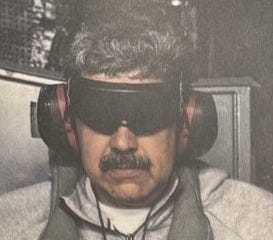
In a stunning overnight military operation with a large number of aircraft and helicopters, US forces launched airstrikes across Venezuela and captured President Nicolás Maduro and his wife, Cilia Flores—reportedly without US fatalities or loss of equipment. Elite units executed the raid in darkness amid explosions at fortified sites, with the couple flown to New York to face narco-terrorism charges.
Trump’s Mar-a-Lago Press Conference
Military Prowess — Trump described the operation as “one of the most stunning, effective, and powerful displays of American military might” since World War II—a “spectacular assault” on a “heavily fortified military fortress” in Caracas, executed with “breathtaking speed, power, precision, and competence.” He compared it to strikes on Soleimani, al-Baghdadi, and recent Iranian nuclear actions (”Midnight Hammer”).
Execution Details — Despite heavy involvement (”many helicopters, many planes, many people”), “not a single American service member was killed” and “not one piece of equipment lost.” Venezuelan forces were “completely overwhelmed and very quickly incapacitated” in the dead of night, with Caracas lights largely off due to US “expertise.”
Narco-Terrorism Justification — Trump accused Maduro and Flores of a “campaign of deadly narco-terrorism against the United States and its citizens,” claiming drugs “mostly come from a place called Venezuela” and that each intercepted boat “kills on average 25,000 people.”
Interim US Control — In a direct assertion of authority, Trump stated: “We are going to run the country until such time as we can do a safe, proper, and judicious transition”—emphasizing the need to prevent chaos and ensure “peace, liberty, and justice” for Venezuelans, including many now in the US.
Oil Industry Involvement — Trump vowed major economic intervention: “We’re going to have our very large United States oil companies, the biggest anywhere in the world, go in, spend billions of dollars, fix the badly broken infrastructure, the oil infrastructure, and start making money for the country”—signaling deep private-sector roles in reconstruction.
Immediate Aftermath
Opposition Response — María Corina Machado swiftly declared “the hour of freedom has arrived,” issuing a written statement welcoming the developments and urgently calling for Edmundo González—widely recognized internationally as the legitimate winner of the fraudulent 2024 election—to be immediately sworn in as president. Venezuelan exile communities, particularly in Doral, Florida, erupted in massive celebrations.
Acting Leadership Vacuum — Vice President Delcy Rodríguez appeared on state TV demanding “proof of life” for Maduro shortly after the raid. President Trump responded by posting a photo on Truth Social showing Maduro aboard the USS Iwo Jima (en route to New York), appearing in a gray tracksuit with possible sensory-deprivation gear (eye coverings and headphones). This has intensified the constitutional crisis—per Article 233 of Venezuela’s Constitution, Rodríguez should assume interim power and call elections within 30 days—yet remaining Chavista figures like the attorney general continue to insist Maduro is still leader, despite his confirmed custody.
US Domestic Reactions — Reactions are polarized: Trump called critics “weak and stupid” in interviews, while Democrats such as Sen. Ruben Gallego labeled it an “illegal war” that turns the US from “world police to bully.” Some warn of political costs, potentially forcing mid-term scaling back if public support wanes.
International Reactions Overview — Published statements reveal deep divisions: Strong condemnations from the UN (calling it a “dangerous precedent”), France, Brazil (”unacceptable line”), Mexico, Cuba, Russia, and China (”armed aggression”), contrasted by enthusiastic praise from Argentina’s President Milei (”new freedom”) and cautious backing from regional anti-socialist figures.
Carl Bildt’s Assessment — Former Swedish Foreign Minister Carl Bildt observed that “no one will grieve for Maduro,” whose repressive regime destroyed a once-prosperous nation through mismanagement and authoritarianism. However, he stressed the “questionable legality” of unilaterally removing disliked leaders—highlighting the delicate balance between upholding international law as a “vital foundation” and acknowledging Maduro’s lack of legitimacy after rigged elections. Bildt warned that strong countries invading weak ones sets “strongly concerning” precedents (particularly for Russia and China), questioned the “narco-terrorism” framing (noting most drugs linked to over 100,000 annual US overdoses originate elsewhere, like Mexico as a “de facto larger drug area,” fueled by American demand and arms exports), and reiterated that self-defense requires an armed attack—leaving the action with a “weak or nonexistent legal basis” while noting required 60-day congressional reports under terrorism paradigms.
Longer-Term Implications
US Intentions on Oil — Trump’s explicit vow for major US firms to invest billions rebuilding Venezuela’s oil infrastructure confirms deep economic stakes, aiming to revive production from the world’s largest reserves while generating revenue—aligning with broader goals of energy independence from Middle Eastern suppliers.
Democratic Transition — Maduro’s removal clears a path for González and Machado to potentially lead a transitional government, supported by early military defections. Yet Trump’s declaration of running the country until transition raises fundamental questions about how much direct control Washington will exert and whether a truly independent Venezuelan process can emerge.
Potential Escalation to Mexico — Trump has repeatedly warned that “something is going to have to be done“ regarding Mexican cartels, having pressured President Claudia Sheinbaum to act—fueling concerns of similar unilateral strikes elsewhere in the region.
Russia and China Likely to Disengage — Analysts anticipate Moscow and Beijing will rapidly withdraw remaining support for Chavista remnants, as they prioritized strategic influence over personal loyalty to Maduro and have little interest in direct confrontation with the US (similar to their Syria exit after Assad’s fall).
Trump’s Security Strategy — This fits an emerging doctrine targeting “narco-states” through unilateral action for security, energy, and anti-cartel goals—but lacks congressional authorization, prompting calls for oversight amid fears of overreach.
Civilian Casualties and Humanitarian Impact — Venezuelan officials report civilian injuries from the strikes (no confirmed deaths), while US sources emphasize minimal losses—underscoring the human toll even as opposition supporters celebrate the regime’s fall.
Global Precedents and Risks
International Condemnation on Sovereignty — French Foreign Minister Jean-Noël Barrot asserted the operation “violates the principle of not resorting to force,” stressing that “only the sovereign people themselves can decide their future“—a view echoed across Latin America and beyond.
Global Precedent Risks — Critics highlight dangerous normalization of unilateral regime change: What is going to stop China from taking Taiwan or any great power from similar interventions without consensus or approval?
The Maduro era ends dramatically—but Trump’s vows to temporarily “run the country” and deploy US oil giants to rebuild infrastructure branch the future toward overt American oversight. Latin American reactions evoke fears of a revived Monroe Doctrine, positioning the US as dominant in its traditional sphere of influence—echoing 20th-century interventions in Nicaragua, El Salvador, or Panama.
History shows such interventions often produce complex, unintended consequences; this one risks lasting hemispheric tension and erosion of global norms. Who does Trump think he is? By what authority does one country not only decide but actively run another’s affairs? If that precedent holds, other powers have the same right over the US. Buckle up for a volatile 2026.
Tracking this evolving story closely. Thoughts: Genuine push for democracy and security, or pretext for control and profit? What precedents does this set for Russia, China, or others?
Stay tuned.
Corrupt convicted felon pedophile Putin puppet can’t run his own country except into the ground! He took Joe Biden’s economy and is intentionally destroying it so he can be a Nazi dictator!
Oh no another crisis… All of these people have managed to knock the entire planet off of its axis in 12 months! And Americans are too comfortable to be uncomfortable for a few months in order to stop it! I used to have faith in America to a certain extent Because I'm older and jaded and I know how things work! I don't anymore!