Maduro's FAFO Reckoning: From Caracas Dance to New York Cell
Oil Donors' Influence, and CBS's Exclusive Scoop Amid Media Shifts

In a timely discussion featuring Joyce Vance alongside former Biden National Security Advisor Jake Sullivan and Deputy Jon Finer, the conversation dissected the stunning US military operation that captured Venezuelan President Nicolás Maduro on January 3, 2026. As we enter 2026 amid escalating global tensions and domestic challenges, these events highlight a shift toward assertive unilateralism abroad and institutional caution at home. Below are key takeaways from the Venezuela analysis, followed by pressing domestic developments and a dedicated section on judicial leadership.
Domestic Highlights
Epstein Files Transparency Act Non-Compliance: The Epstein Files Transparency Act (H.R.4405) required full disclosure by December 19, 2025, but AG Pam Bondi and DOJ provided only partial, heavily redacted documents. This has sparked bipartisan outrage, with lawmakers—including Act sponsors—threatening inherent contempt proceedings or even impeachment against Bondi to enforce transparency.
Unsealed: Abrego Garcia: In the Middle District of Tennessee before Judge Waverly D. Crenshaw, Jr., a newly unsealed order requires disclosure of documents showing high-level DOJ involvement in indicting Jose Abrego Garcia—contradicting claims of a purely local decision. The timeline (indictment 58 days after Abrego Garcia’s successful deportation challenge, affirmed by the Supreme Court in April 2025) and internal emails prioritizing the case post-lawsuit raise serious vindictive prosecution concerns, potentially grounds for dismissal while underscoring due process protections.
Second Session of the 119th Congress: The second session convenes January 6, 2026, resuming legislative business. As a co-equal branch, Congress must act as a rival power center through oversight and checks—its tools (impeachment, investigations, delays) exist, but willingness is key. This includes enforcing the War Powers Resolution against unauthorized actions like the Venezuela operation.
Jack Smith Update: As 2026 began, the House Judiciary Committee released transcripts and footage of former Special Counsel Jack Smith’s December 17, 2025, testimony. Smith defended his indictments as evidence-based (with proof beyond reasonable doubt for convictions), denied political motivation, called Trump “the most culpable” in the January 6 conspiracy, and stated the Capitol riot “does not happen without Trump.” The release fueled ongoing accountability debates despite case closures.
Ninth Circuit Ruling on National Guard Deployment: The Ninth Circuit’s December 31, 2025, decision in Newsom v. Trump upheld ending federalization of the California National Guard, returning control to Governor Gavin Newsom—who hailed it a “major win” after Trump conceded. It highlights persistent judicial checks on executive overreach.
Legal Highlights
Release and Overall Assessment: Chief Justice John Roberts released his 2025 Year-End Report on the Federal Judiciary on December 31, 2025. The document reflects on the judiciary’s role through a historical lens but avoids addressing current crises like ethics scandals or presidential attacks on courts.
Indirect References to Threats: The Chief Justice notes a 9% increase in civil cases against the administration and constitutional protections for judicial independence, alluding to historical threats without confronting present realities like heightened security needs amid criticism.
Omission of Current Crises: Absent is acknowledgment of Supreme Court decisions expanding presidential power (including immunity rulings) or ethics scandals involving undisclosed gifts—no call for a binding ethics code.
Historical Number of Justices: The report notes that of the Declaration’s 56 signers, 25 were lawyers and 16 became judicial officers, including two Supreme Court Justices; the original Court had six members but offers no context on today’s nine-Justice structure.
Supreme Court Caseload: October Term 2024 saw filings drop 9% to 3,856 cases, with 73 argued and 64 resolved via 56 signed opinions (plus four per curiam)—slightly down from the prior term, presented without linking to broader pressures.
Lower Courts’ Caseload: Appellate filings rose 5% to 41,824 (50% pro se); district civil cases up 4% to 303,563 and criminal defendants up 13% to 79,029 (driven by immigration/drug offenses in border districts); bankruptcy filings increased 11% to 557,376 (mostly consumer).
Recent Shadow Docket Ruling: On December 23, 2025, the Supreme Court rejected Trump’s emergency request to deploy National Guard in Chicago-area immigration enforcement, upholding a lower court block—a rare executive check the report ignores.
International Highlights
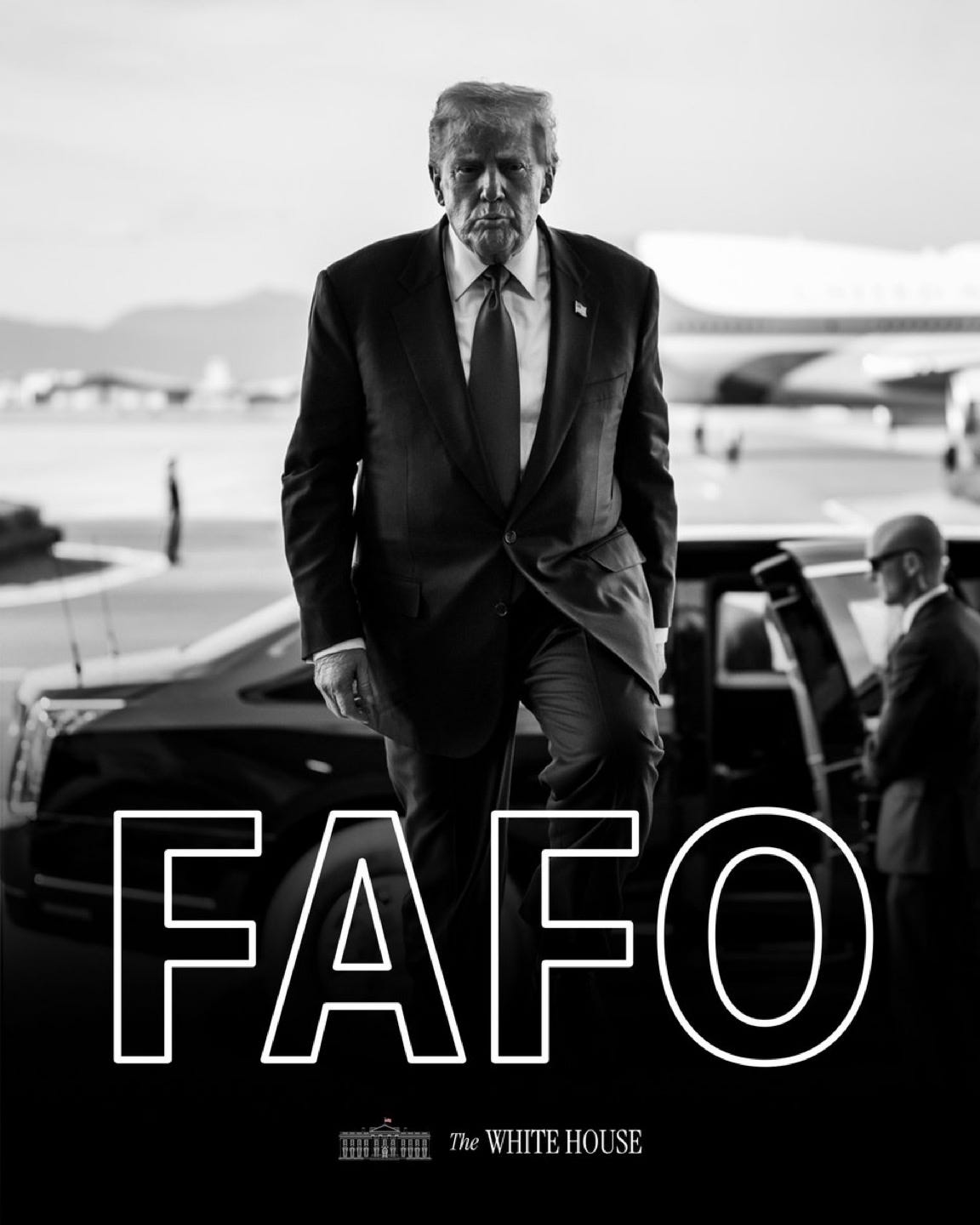
FAFO Moment: Maduro’s defiant imitation of Trump’s signature dance—fist-pumping to a ‘No War, Yes Peace’ remix—on November 21, 2024, during a Caracas rally initially drew Trump’s appreciative Truth Social response (”Thank you Nicolás. I appreciate it!”). Later perceptions shifted amid tensions; Rubio (December 2) criticized Maduro for breaking deals, warning Trump would not be “suckered” like Biden. Post-capture, Trump celebrated on Truth Social, with the White House posting ‘FAFO’ (Fuck Around and Find Out) over his photo—signaling consequences.
Media Access and Venezuela Coverage: CBS News broke key details of the Venezuela operation early, prompting speculation it was rewarded for recent shifts: after Paramount Skydance (backed by Trump donor Larry Ellison) acquired CBS, the network settled Trump’s lawsuit over a 60 Minutes interview edit and pulled a critical segment on U.S. deportees to El Salvador’s CECOT prison under new editor Bari Weiss.
Oil Donors and Venezuela Ties: Trump’s emphasis on U.S. firms (Exxon, Chevron) rebuilding Venezuela’s oil infrastructure aligns with major campaign donors in the energy sector, including Larry Ellison, whose support helped secure regulatory approvals for media mergers amid settlements favoring the administration.
The Maduro Indictment: The Southern District of New York superseding indictment charges Nicolás Maduro Moros and co-defendants with narco-terrorism conspiracy, cocaine importation, and weapons offenses, alleging 25+ years of corruption and partnerships with FARC, ELN, Sinaloa Cartel, Zetas, and Tren de Aragua to traffic tons of cocaine, enriching elites while protecting narco-terrorists.
U.S. Military Operation and Capture: On January 3, 2026, U.S. forces airstriked Caracas and captured Maduro and wife Cilia Flores, transferring them to New York for trial. Trump announced temporary U.S. oversight for a “safe transition,” prioritizing oil infrastructure rebuilds by American firms (Exxon, Chevron) reimbursed from resources, with military security and no added taxpayer cost.
Leadership and Legitimacy Questions: Vice President Delcy Rodríguez leads interim, amid asset grab concerns. Opposition leader María Corina Machado (widely viewed as 2024 winner and Nobel recipient) remains sidelined in U.S. statements; potential deals unclear.
Marco Rubio as Contender for Next President: Marco Rubio—Secretary of State, acting National Security Advisor (overseeing CIA), and Venezuela lead—holds unprecedented multi-role influence. Success or failure in Venezuela’s transition could determine his 2029 presidential prospects (potentially succeeding Trump if Vance steps aside).
Geopolitical Parallels: The operation draws parallels to Russia’s Ukraine actions or China’s Taiwan ambitions, potentially normalizing spheres of influence while reshaping energy alliances.
U.S. Domestic Reactions: Polarized: Republicans (Johnson, Thune) praised drug threat reduction; critics (Greene, Massie) questioned priorities; Democrats (Schumer, Kaine) condemned as unauthorized war risk; local leaders decried illegal regime change.
Venezuelan and Global Reactions: Machado welcomed it as freedom’s path; Rodríguez called it imperialist resource grab. Venezuelans abroad celebrated; global responses ranged from UK support for transition to condemnations from Cuba, Mexico, China.
Tragic Drowning off UK Coast: Sarah Keeling (45) died in rough seas off Withernsea January 3, 2026; daughter Grace (15) missing; rescuer Mark Ratcliffe (67) also died. Families supported amid searches.
Economic Highlights
Corporate Bankruptcies Rise: Bankruptcies increased 14% in 2025 to over 700 cases, tightening executive recruitment (especially retail) while creating turnaround opportunities amid mild downturn consolidation.
Housing Market Reset Ahead: Rising bankruptcies (including real estate) could cool demand and depress prices if triggering recession; 2026 forecasts suggest home price declines from shifting migration trends, higher inventory, and ongoing affordability issues—a slow market reset beginning.
Saks Global Leadership Change: Saks Global’s CEO stepped down amid bankruptcy preparations after missing a $100M interest payment, with executive chair Richard Baker assuming control (likely Chapter 11 restructuring, not individual Chapter 13).
Copper Demand Signal: Copper prices surged 36-39% in 2025 (closing near $5.68/lb), indicating industrial growth (”Dr. Copper”); 2026 outlooks vary—bearish declines possible on supply gains, bullish surges from AI/infrastructure demand.
Bond Market Volatility: Bonds showed volatility from inflation/tariff uncertainty, with Treasury yields edging up January 4 (10-year ~4.18%), following the market’s strongest annual gain in five years; long-maturity pressure persists.
T-Bill “Ponzi” Analogy: T-bill ownership draws “Ponzi” comparisons due to rollovers and fractional reserves, echoing Social Security sustainability debates amid fiscal concerns.
USD Strength and Policy Risks: Trust underpins strong USD, but unclear foreign policy on Ukraine, China, Middle East raises potential erosion concerns in volatile global environment.
Interest Rate Projections: U.S. rates may decline gradually (Fed eyeing ~3.25% by end-2026, possible three cuts H1 if labor softens); ECB expected steady at 2-2.15%, with minor cuts to 1.5-2% if data weakens.
Epstein Files Banking Implications: Unsealed December 2025 Epstein files (postmortem SARs from TD Bank, subpoenas to JPMorgan/Goldman/HSBC) prompt auditor concern questions; DOJ’s 400-lawyer review of 5.2M pages could uncover systemic AML bypasses, leading to hefty sanctions or prosecutions if corruption proven.
In these turbulent times, informed discourse is our strongest tool. Thank you for engaging—together, we’re building the community needed to navigate 2026 and beyond. Subscribe for more analysis as events unfold.