Marco Rubio's Valentine's Day Address in Munich: A Love Letter to Europe with Strings Attached
Praise for Shared Heritage and "Child of Europe" Bond – But Firm Preconditions on Migration, Borders, Climate Policy, and Global Order Reform

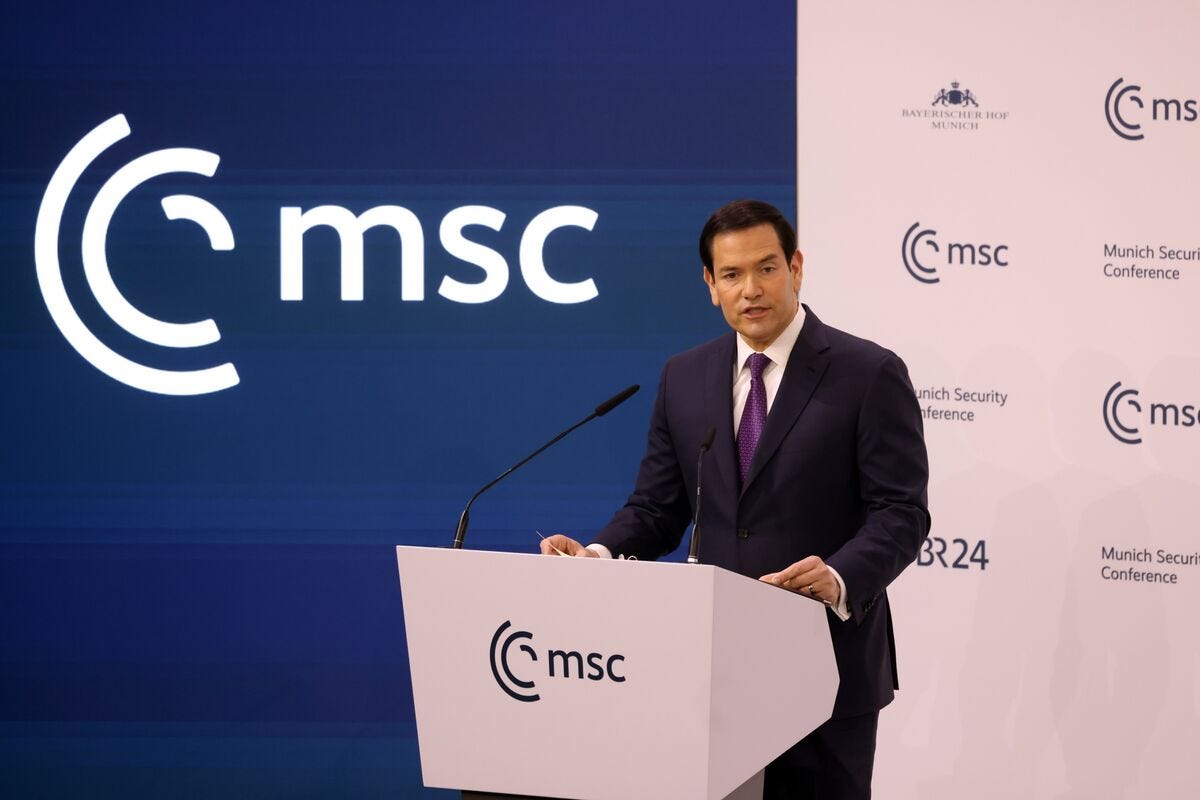
On February 14, 2026, U.S. Secretary of State Marco Rubio delivered a keynote address at the Munich Security Conference that blended deep cultural reverence for Europe’s legacy with pointed criticism of its current trajectory. The speech stood in marked contrast to the more confrontational tone from Vice President JD Vance the previous year.
Rubio ended on an optimistic note: the West can reject decline as a choice, as it did after 1945, and renew its civilization together. Attendees, including major European leaders such as German Chancellor Friedrich Merz, Swedish Prime Minister Ulf Kristersson, French President Emmanuel Macron, UK Prime Minister Keir Starmer, European Commission President Ursula von der Leyen, Ukrainian President Volodymyr Zelenskyy, and NATO Secretary General Mark Rutte, rose for polite applause and a short standing ovation at the conclusion—a notable show of engagement compared to the shock that greeted Vance’s remarks in 2025.
Rubio framed the transatlantic relationship as unbreakable yet conditional: the U.S. wants a strong, unapologetic Europe as a partner, not a dependent one mired in self-doubt, deindustrialization, uncontrolled migration, or reliance on flawed international bodies. He declared that “the United States and Europe belong together,” and repeatedly emphasized that America “will always be a child of Europe,” underscoring the deep, permanent cultural and historical bond: “Our home may be in the Western Hemisphere but we will always be a child of Europe.”
Munich Security Conference Chairman Wolfgang Ischinger (who moderated Rubio’s post-speech Q&A) noted a more constructive tone: still sharp criticism, but with an outstretched hand toward future cooperation. Rubio’s message appeared calibrated to signal openness while maintaining core Trump-era demands, prompting a “sigh of relief” in the hall—as Ischinger himself described it live, in stark contrast to the tension from Vance’s 2025 address.
International
Deep Historical and Cultural Bonds — Rubio opened with an extended tribute to the shared civilization between the U.S. and Europe, rooted in Christian faith, language, ancestry, art (from Michelangelo and Shakespeare to The Beatles), and scientific achievements. He emphasized that America is “a child of Europe” and “will always be a child of Europe,” highlighting contributions from English, Scots-Irish, German, French, Spanish, and other European settlers. He positioned the U.S. as forever tied to Europe’s fate, invoking the lessons of two world wars: “Our destiny is, and will always be, intertwined with yours.”
Defense of a Specific Way of Life — Armies fight for nations, peoples, and ways of life—not abstractions. Rubio argued that the West must defend a proud heritage and aim for mastery over its economic and political destiny, rejecting guilt, shame, or complacency. “We do not want allies who are shackled by guilt and shame,” he said. “We want allies who are proud of their culture and of their heritage.”
Critique of Deindustrialization and Policy Choices — He described Europe’s loss of industrial capacity and supply-chain sovereignty as a “foolish but voluntary transformation,” driven by misguided policies including what he called a “climate cult” and excessive regulatory focus on climate issues. Rubio argued these choices have stripped nations of their wealth, productive capacity, and independence, leaving the West dangerously vulnerable and dependent on adversaries like China. He further criticized an alliance “paralyzed into inaction by fear—fear of climate change, fear of war, fear of technology”—implying a need to dial back such priorities in favor of bold economic and security action.
Mass Migration as an Existential Threat — Rubio called uncontrolled migration a crisis “destabilizing societies all across the West” and an “urgent threat to the fabric of our societies and the survival of our civilization itself.” Controlling borders is a core act of sovereignty and essential to preserving cultural fabric—not xenophobia, but survival.
Reform of Global Institutions and the “Rule-Based Order” — The UN and similar bodies have “played virtually no role” in major crises (Gaza, Ukraine, Iran, Venezuela) and “have no answers.” Rubio insisted on reform rather than abandonment, rejecting the idea that violators of international law can hide behind it. The current order often advantages adversaries who ignore rules.
A Forward-Looking Alliance — Beyond military ties, Rubio called for joint reindustrialization, control of critical minerals, advances in AI, space, automation, and competition in the Global South. He urged unshackling Western ingenuity for a “new Western century.”
No Exit from NATO — Rubio reaffirmed commitment to NATO but stressed it must defend a strong, self-reliant Europe. The U.S. wants allies who can stand on their own, proud and capable—not weak or ashamed. “Being a part of NATO is not only Europe’s competitive advantage, it’s also the United States’ competitive advantage,” he noted.
Domestic
“White European” Core of U.S. History — Rubio’s emphasis on America’s founding by specific European immigrant groups (English, Scots-Irish, Germans, etc.) reflects a MAGA-inflected view of U.S. history as rooted in a “white European” core—often sidelining indigenous peoples, later minorities, and demographic shifts.
Ties to U.S. Demographic Changes — This narrative connects to America’s ongoing demographic shifts: the proportion of Americans classified as white (of European descent) is declining, while groups like Latinos (Rubio himself, born in Cuba and classified as Latino) grow. The 250th anniversary of U.S. independence in 2026 amplifies this framing of a “European-origin” national essence.
MAGA-Aligned Vision of Europe — Europe is viewed through an American prism: the Europe the U.S. wants to partner with aligns with MAGA ideals—culturally confident, border-secure, and demographically preserving its “original” character.
Tension in Self-Understanding vs. Prescription — Blanck highlighted a clear tension between how Europeans see themselves and the U.S. prescription for what Europe “should be.” Rubio warns of “civilizational erasure” through immigration, urging Europe to strengthen its “original groups” via strict borders.
Cooperation on American Terms — Continued cooperation is on offer, but on American terms—a transformed transatlantic bond where Europe adopts policies resonant with U.S. nationalist priorities.
Rubio’s Munich address was no mere diplomatic nicety. It was a clear challenge wrapped in praise: America remains committed to the West, but only to a revitalized, sovereign, culturally self-assured version of it. The applause from leaders like Merz, Kristersson, and Macron suggests some European figures see an opening for reset amid their own debates on migration, industry, and defense. Others may view it as continued pressure to align with Washington’s worldview.
Whether this leads to renewed alliance or deeper divergence will depend on Europe’s response—particularly on immigration policy, border control, reduced emphasis on climate-driven regulations, defense spending, and willingness to challenge the status quo. For now, Rubio has laid down a path forward: pride over shame, sovereignty over supranational constraints, and shared action over managed decline.
The transatlantic story isn’t over. But it’s being rewritten on new terms—terms that appear to center heavily on stricter immigration controls and a dialing back of what Rubio framed as excessive climate priorities.
Happy Valentine’s Day! Love you all very much 💘
Europe. You are doing fine. Embrace your diversity and pro planet policies. Keep supporting democracy. Thank you for helping Ukraine.
They were being polite. Reports I've seen, say that Europeans are pissed . I don't blame them