Mark Carney's Davos Bombshell: Declares "Permanent Rupture" with Trump’s America
Canadian PM signals end of U.S.-led order and rise of independent alliances—echoed by Krugman’s take on economic fallout and domestic turmoil.

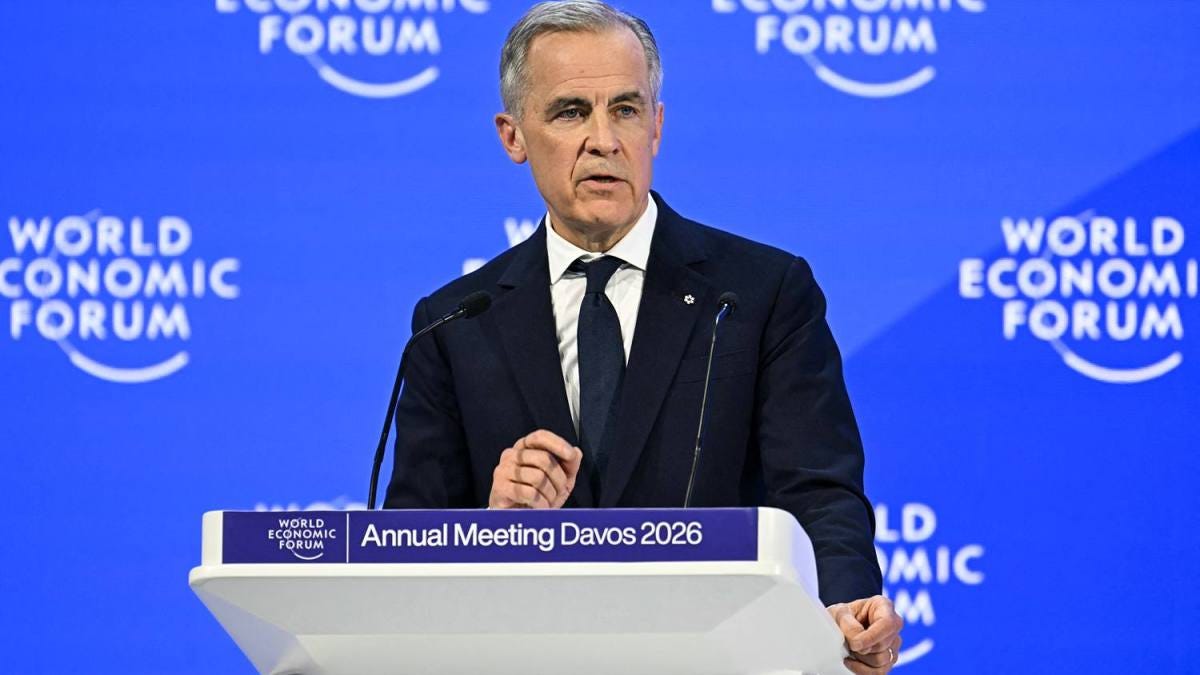
“Let me be direct”—Canadian Prime Minister Mark Carney delivered a calm but devastating verdict at Davos on January 20, 2026: the global order is in a “rupture—not a transition,” driven by U.S. economic coercion under Trump. Without naming names, he warned that weaponized tariffs and broken trust make cooperation irrational, and affirmed Canada’s unwavering support for Greenland’s sovereignty and NATO commitments.
Europe and Canada are building systems that no longer assume U.S. restraint. Nobel economist Paul Krugman sees the same fracture—Trump’s Greenland retreat as classic bluster collapsing against Europe’s “bazooka” tool—while warning of a U.S. economy that’s “bad in weird ways” and personal reckonings like Michael Cohen’s.
International
Mark Carney eviscerates Trump in Davos speech, declares permanent global “rupture” Carney stated the world is experiencing a “rupture—not a transition,” blaming U.S. coercion (tariffs as leverage) for eroding shared rules and trust. He called the old U.S.-led bargain over, urged democratic nations to build independent resilience, and firmly backed Greenland and Denmark’s sovereignty against pressure.
Carney warns of irreversible trust collapse and urges new alliances He described American hegemony’s past role in providing global public goods (e.g., stable finance, security) as a “bargain that no longer works,” urging democratic nations to build resilient systems independently. He cautioned that repeated violations make cooperation unsustainable. Delivered calmly to Davos elites, the speech positions Canada as a leader in what comes next—reinforcing alliances amid U.S. isolationism, without nostalgia or aggression.
Domestic
Michael Cohen’s cry for truth, redemption, and a mass pardon Cohen reflects on the personal toll of testifying under fire, the pain of abandonment by former allies, and his refusal to be silenced: “I stood up… I told the truth… I’ve done it.” He continues advocating (with Jesse Jackson Jr.) for an executive order granting full pardons to millions convicted of nonviolent federal felonies who have completed their sentences—framed as restorative justice for ~70 million Americans still bearing the “scarlet letter” of a felony long after punishment ends. His words echo a broader national mood of disillusionment, where personal integrity becomes both weapon and shield.
Cohen’s coercion claims and pardon speculation In a January 2026 Substack post (amplified by Fox News), Cohen alleges New York prosecutors under Alvin Bragg and Letitia James “pressured and coerced” him into anti-Trump testimony through leading questions and ignored exculpatory evidence to advance a political narrative against Trump. Responding to these claims, he recalls the exhaustion of partisan congressional grilling: “Half the group mocking, the other group asking questions what it’s all about. Think bout what they did to me.” This has fueled speculation that Cohen—Trump’s former fixer once linked to the withdrawn “Katie Johnson” (pseudonym) silencing allegations—may be maneuvering for favor or a pardon, possibly via White House outreach and calls for DOJ scrutiny of Bragg and James ahead of midterms. Cohen insists the pardon push is about broad reform; critics see it as a bid for personal redemption or leverage in Trump’s circle.
Trump administration’s approach to DEI hiring The Trump administration claims to push back on DEI practices in hiring but often attacks free speech in other ways and fails to build broad consensus. Despite opportunities, they haven’t launched high-profile EEOC investigations or congressional subcommittees for discovery on DEI in institutions—possibly because resolving the issue would remove a key grievance for their base. This leads to pessimism, as the administration seems more interested in perpetuating division than impartial reform.
Democratic perspective on DEI and potential shifts Democrats show little moderation on DEI hiring; while direct rhetoric has softened slightly, there’s still an underlying sense that certain groups (e.g., white men) “don’t quite belong.” No prominent Democrat has publicly rejected racial or demographic “buckets” in hiring—e.g., a hypothetical where Kamala Harris could have won by emphasizing unity over division. This contributes to a “ping-pong” between extremes, with neither party advocating for simple fairness without group-based preferences.
Economy
Europe shows unexpected backbone against U.S. bullying When Trump pushed hard on Greenland (threatening tariffs and even implying force), European leaders responded with spine—deploying troops as a “tripwire” (Operation Arctic Endurance) and invoking the EU’s new anti-coercion “bazooka” tool (the Anti-Coercion Instrument, a streamlined mechanism for rapid retaliation against economic coercion). Krugman calls it a case of Brave Sir Robin (Trump) running away when faced with real pushback. Europe has roughly equal economic leverage over the U.S. as vice versa, and this time they used it effectively.
Greenland fiasco: Classic “TACO” pattern—chicken out, then declare victory No substantive change occurred; the U.S. already had strategic access rights. Resources remain buried under ice. Trump backed off tariffs after a meeting with NATO’s Mark Rutte, announcing a vague “framework” deal. Krugman views it as Trump realizing he couldn’t bully through—and predicts the issue could resurface given his chaotic style.
Davos signals the end of U.S. leadership in the liberal order? Some outlets (e.g. New York Times) called Trump’s rant a landmark announcement ending American stewardship of the global democratic system—handing wins to China. Krugman agrees Beijing is likely celebrating, as U.S. soft power and alliances erode. Yet he sees a silver lining: Europe may finally pursue strategic autonomy and become the “superpower nature intended,” if it overcomes internal divisions (unanimity requirements, farmer lobbies blocking deals like Mercosur).
U.S. economy after one year: Not booming, not crashing—just strangely disappointing Stocks are up globally (even more in Europe), but claims of U.S. dominance fall flat. Growth looks strong on paper, yet wages and employment tell a different story: unemployment creeping higher, hiring frozen. It’s brutally hard to find a job—whether you’re a young entrant or laid-off worker—creating psychological strain (no one dares quit). Consumer confidence is incredibly low, fueled by a sense of betrayal: many believed Trump’s “day one” promises on prices, only to see him dismiss visible grocery costs.
Tariffs reality check: Americans pay, despite the claims Trump repeatedly insists foreign countries foot the bill. Krugman notes near-unanimous economist agreement that Americans bear the cost. Some relief comes from tariff avoidance (exploiting loopholes), so effective increases are roughly half what’s announced—but prices still rise (e.g., Krugman’s stockpile of Italian pasta).
Business community’s Faustian bargain turns to fear Many executives backed Trump expecting tax cuts and deregulation (which partly happened). But rule of law has eroded; speaking out risks punishment. Oligarchs often believe they control the strongman—until he controls them. Boardrooms now operate in fear rather than greed.
Assault on Fed independence: A dangerous power grab The Fed’s monetary tools are a near-frictionless gas pedal/brake for the economy—too easy to politicize (see Turkey, Venezuela, Argentina). Independence provides crucial delay against impulsive interference. Krugman praises Jerome Powell’s unusually blunt defense, noting it began earlier (Lisa Cook) and that Powell’s reputation, wealth, and personal resources give him rare strength to resist. Without it, politicized policy risks ruinous inflation or worse.
Market
Economic malaise persists Krugman describes the economy as “not great, but bad in weird ways”—strong headline GDP and global stock gains (even higher in Europe) mask underlying weakness in wages, employment, and hiring. Unemployment creeps up, job searches drag on for months, creating psychological strain and reluctance to quit. Consumer confidence remains incredibly low due to unfulfilled promises (e.g., immediate grocery price cuts) and a sense of betrayal.
Trump sues JPMorgan for $5bn over debanking In a major escalation, President Trump filed a lawsuit in Miami-Dade County state court seeking at least $5 billion in damages from JPMorgan Chase and CEO Jamie Dimon. Trump alleges the bank unfairly closed his and his affiliated companies’ accounts in 2021 for “political and social motivations” tied to his conservative views and “woke” beliefs, including placing him on a “blacklist” of non-compliant or malfeasant individuals. JPMorgan denies closing accounts for political reasons, citing instead legal/regulatory risk and compliance rules (e.g., for politically exposed persons).
Intel shares drop >10% on supply issues Intel shares dropped as much as 11% in after-hours trading after the chipmaker issued disappointing guidance, citing manufacturing capacity issues and supply constraints that limited chip output and growth. Despite government support (including a 10% U.S. stake celebrated by Trump) and investments from Nvidia, Intel struggles with yields on its 18A process, depleted inventory entering 2026, and reliance on TSMC amid broader industry shortages in memory chips driven by AI demand.
Legal
Jack Smith testifies: Trump caused Jan. 6 Former special counsel Jack Smith, in his first public testimony before the House Judiciary Committee on January 22, 2026, stated unequivocally: “Donald Trump is the person who caused Jan. 6, that it was foreseeable to him and that he sought to exploit the violence.” Smith described the probe as uncovering an “unprecedented criminal scheme to block the peaceful transfer of power,” based on facts and law leading to indictments. He emphasized non-partisan evidence, including strong testimony from Republicans who supported Trump, and rejected claims of political pressure from the Biden administration.
ICE whistleblower: Warrantless home entries authorized On January 22, 2026, a whistleblower revealed that U.S. Immigration and Customs Enforcement (ICE) agents have been explicitly instructed to disregard the Fourth Amendment’s protections against unreasonable searches and seizures. This allows warrantless entries into private homes during immigration enforcement operations, reportedly enabling “no-knock” raids and forced entries without judicial oversight in many cases. Critics argue this directly violates constitutional safeguards—comparable to how warrantless searches would infringe on Second Amendment rights if applied to firearms—raising serious concerns about due process, civil liberties, and potential abuse of power under the current administration.
Whistleblower claims NSPM-7 weaponized against dissent A whistleblower disclosure on January 22, 2026, claims the Trump administration is operationalizing National Security Presidential Memorandum 7 (NSPM-7) to criminalize political opposition. Under Attorney General Pam Bondi’s directive, ideological dissent is treated as a “red flag” for terrorism scrutiny. Protected free speech activities—such as reporting on ICE or Border Patrol movements, criticizing immigration enforcement, or voicing anti-regime views—are allegedly now grounds for domestic terrorism investigations. The source asserts the FBI has shifted from counterintelligence and white-collar crime to immigration enforcement and targeting those Trump calls the “enemy within,” describing the move as turning dissent into a prosecutable offense and warning that “ideology itself becomes a red flag,” with citizens ruled “like a king.”
House passes spending bill despite Democratic ICE revolt On January 22, 2026, the House narrowly approved a spending package funding key government agencies, including the Department of Homeland Security, bringing Congress closer to the January 30 deadline to avert a shutdown. The measure kept ICE funding roughly flat—rejecting Trump’s requested $840 million increase—while rejecting deeper cuts to the CDC and NIH. It passed 220-207, with 206 Democrats opposing it over concerns about ICE conduct following the fatal shooting of Renee Good in Minneapolis by an ICE agent. Democrats, led by Minority Leader Hakeem Jeffries and Appropriations top Democrat Rosa DeLauro, protested “lawless conduct” by ICE and proposed reins (e.g., blocking detention of U.S. citizens, ensuring congressional oversight of facilities), all rejected by Republicans.
Mark Carney’s Davos verdict and Krugman’s analysis converge: the U.S.-led era is fracturing, allies are moving on, and domestic strains deepen. From Stockholm, we watch how this reshapes markets, trade, and geopolitics.
What do you think—will Carney’s “rupture” accelerate Europe’s independence? Can the U.S. economy recover its footing? Share below. Subscribe for more 2026 finance and politics insights.
A tragedy of biblical proportions
Whilst I appreciate your attention to these matters, you keep quoting Carney as saying “permanent rupture.” You even use quotation marks. He did NOT say permanent. Please refrain from sensationalizing for clicks. Carney is a brilliant, experienced politician who chooses his words very carefully. Canada does go in for high drama, polarized thinking. That’s projection from a country that does.