Shadows of Accountability: Transparency, Pressure, and Warning Signs
As 2025 closes, stonewalling persists, economies strain, and "peace" proposals raise alarms amid high-stakes Mar-a-Lago talks

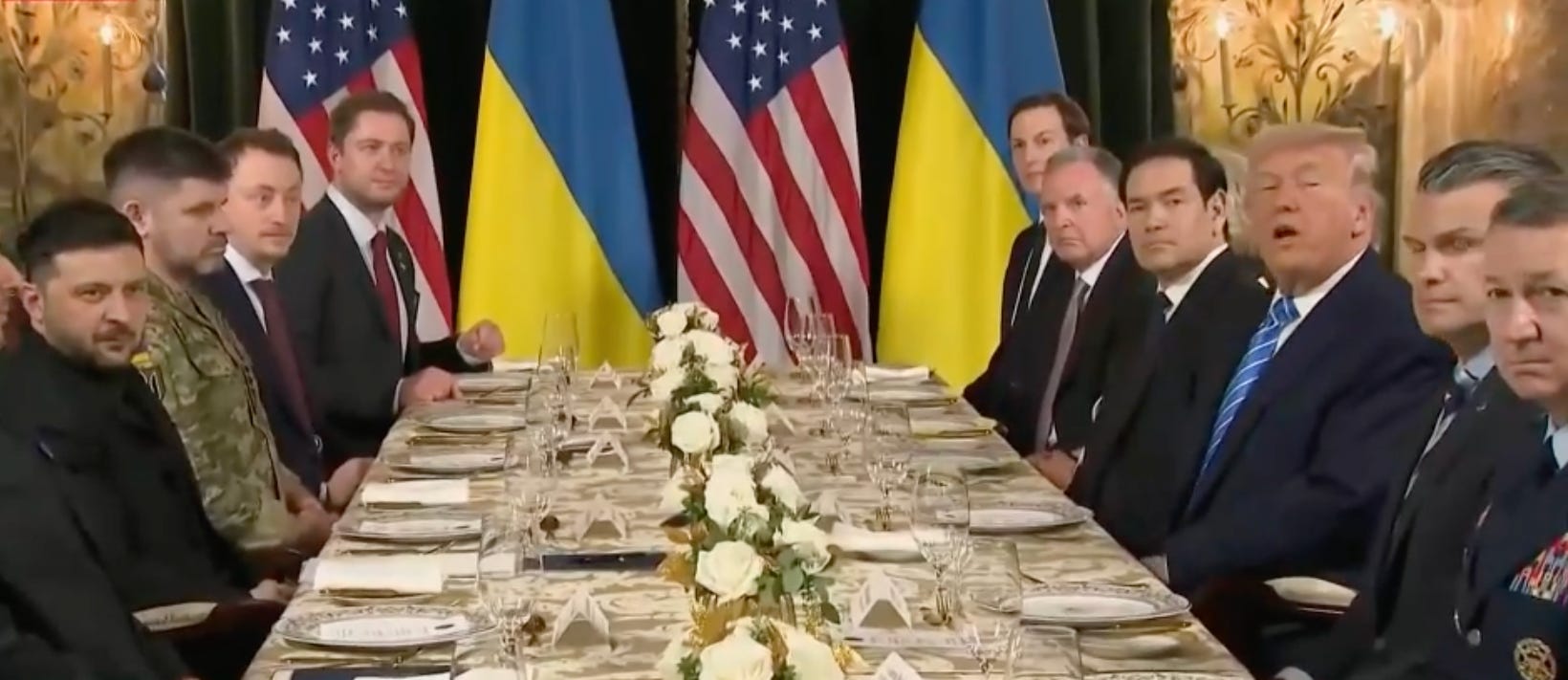
On this day—December 28, 2025—the Mar-a-Lago meeting between President Trump and Ukrainian President Zelenskyy has captured global attention. Following a lengthy, “friendly” Trump-Putin phone call, critics like Lev Parnas (in a live discussion with Ben Meiselas of MeidasTouch) describe the resort dining-room setting as deliberate disrespect amid ongoing Russian bombardment, framing the entire event as coerced theater rather than genuine diplomacy. These developments intersect with domestic evasion in high-profile investigations and economic pressures, highlighting fragile accountability across multiple fronts.
Domestic Developments
Ongoing Stonewalling and Selective Protection: A letter from Attorney General Pam Bondi to Kash Patel demanded all relevant documents be centralized at Main Justice, yet the Southern District of New York (SDNY)—the office that prosecuted both Epstein and Maxwell—only recently “discovered” an additional million pages. This, from the most obvious repository, suggests either profound incompetence or deliberate delay in internal sharing.
Indefensible Redactions Favoring Certain Figures: Releases include bizarre disparities, such as fully redacting a post-2015 photo of Trump with Maxwell (found on Steve Bannon’s phone and flagged in an FBI email as potentially useful), while releasing similar Clinton-Maxwell images. No justification exists under the Epstein Act, which bars redactions for embarrassment; critics see misuse of the Privacy Act to shield implicated individuals beyond victim protections.
The Failed Cover-Up and Persistent Tactics: The “Stonewall memo” broadly claimed no evidence for investigations (e.g., involving Prince Andrew), aiming to “deep six” the matter—a strategy that crumbled but lives on through minimal, politicized releases. Early dumps highlighted Clinton (with DOJ spin) and included dubious/fake documents muddying waters, described as orchestrated games over victims’ trauma.
Chaotic, Non-Compliant, and Victim-Hostile Releases: Documents appear in unorganized numeric batches without dates, context, or modern cross-indexing/sortability (e.g., by name or type)—violating the law’s searchability requirement. Victims themselves haven’t received their own 302 transcripts, adding insult. Additional context includes reports of Deputy AG Todd Blanche visiting Maxwell in prison and facilitating her transfer to a more comfortable facility, alongside Trump not ruling out a pardon.
What to Expect Next: Coming days/weeks may bring FBI 302 victim/witness interviews, investigative timelines, and tip tranches—potentially naming prominent figures like Bill Clinton or others. If withheld, lawsuits could force clarity.
Congressional Leverage Underused: Tools like funding restrictions, contempt resolutions, censure, or civil litigation remain available for bipartisan use. Individual members lack full standing, but collective action (as in past defense budget leverages) could end the impasse. Stonewalling—whether through incompetence or intent—must not prevail.
Economy Watch
Finland Advances Data-Driven Defense: The Finnish Defence Forces have unveiled a new strategy emphasizing a data-focused operational shift and greater AI integration. Goals include improved command and control, secure information exchange, automation of routine tasks, and uniform data management across lifecycles—positioning data as a critical resource in modern warfare alongside traditional domains.
U.S. Corporate Bankruptcies Surge: Filings reached at least 717 through November 2025—the highest since 2010—driven by high interest rates, inflation, and decades-high tariffs hammering import-dependent firms. Industrials in manufacturing and transportation lead the spike, with companies unable to pass costs to consumers. Sectors like retail and airlines have seen major collapses, underscoring broader economic strain.
International Spotlight
Mar-a-Lago Meeting Dynamics and Disrespect Allegations: Zelenskyy’s arrival for talks in the resort’s dining room—amid press access and holiday atmosphere—was called profoundly disrespectful by Lev Parnas and Ben Meiselas, evoking casual opulence (well-done steaks, past events) while Russia bombs Ukraine. Parnas, drawing from past experience, described it as a “prolonged push attack” coordinated by Kushner and Witkoff, with no red-carpet welcome and Trump receiving “marching orders” from Putin beforehand.
Pre-Meeting Trump-Putin Call: Trump held a “good and very productive” over-hour-long call with Putin (initiated by the US, per Moscow), exchanging Christmas greetings in a “friendly tone.” Kremlin aides said Trump listened to Russia’s Ukraine assessment, agreeing a Ukrainian-European ceasefire push would “only prolong” the war, and urging quick Donbas decisions. Another call is planned post-Zelenskyy meeting.
Key Figures at the Mar-a-Lago Table: On Trump’s side: Secretary of State Marco Rubio (leading U.S. diplomacy); Chief of Staff Susie Wiles; special envoy Steve Witkoff (key negotiator, credited with advancing talks); Jared Kushner (Trump’s son-in-law and longtime advisor); General C.Q. Brown Jr. (Chairman of the Joint Chiefs of Staff, providing military perspective); and Deputy Chief of Staff Stephen Miller (typically domestic-focused, notably on immigration—presence raises questions about broader agenda). Note: No reports indicate journalist Lesley Stahl was present at the negotiating table.
Trump as Potential “Joker” in Negotiations?: Some observers liken Trump’s role to a “joker” in youth soccer—a neutral or floater player who supports both sides, passes freely, but cannot score goals directly. Critics question if his pre-meeting coordination with Putin and economic-focused framing position him as facilitating play without committing to decisive enforcement against aggression.
Theatrics Over Genuine Peace: Parnas emphasized the talks as “all theatrics,” with Putin rejecting even original plans—demanding surrender while escalating attacks. Ukraine/Europe seek U.S. disengagement to allow deeper strikes into Russia (currently restrained by U.S. involvement); paradoxically, Ukraine wants support but prefers independence over coerced concessions.
Ukrainian Counter-Bluff and Resolve: Zelenskyy/Europe call Trump’s/Putin’s bluff by offering territorial concessions tied to a 30-90 day ceasefire and free/fair referendum (including Russian-occupied areas) with U.S./European guarantees—exposing bad faith if rejected. Ukrainian officials warn stopping fight risks gulags/subjugation; society fights for survival despite fatigue/fractures.
Trump’s Public Framing and Mismatches: Trump described the meeting as productive, praised Zelenskyy’s bravery, highlighted economic rebuilding benefits, set no deadlines (but warned of prolonged war/more deaths otherwise), and ignored Russia’s invasion/war crimes. Analysts note fundamental mismatch: Trump’s deal-making vs. Ukraine’s view of Russia as untrustworthy invader.
Broader Geopolitical Risks: Talks risk short-term “fix” fragile long-term, driving NATO wedge/emboldening Putin. Europe lacks unified “United States of Europe” military posture—configured for overseas choice wars, not continental survival—heightening concerns over U.S. withdrawal.
Major Conflicts of Interest in the “Peace” Plan: Trump’s original 28-point plan (revised to ~20 points) contained provisions like Point 26’s full amnesty for all war actions, barring future claims and potentially shielding atrocities from accountability—no personal or familial relationships justify such impunity. Critics view it not as true peace but Russia’s takeover scheme laced with U.S. business perks and likely benefits for Trump, friends, and family. Oversight falls to the Office of Government Ethics (OGE) and State Department ethics officials (e.g., Bureau of Conflict and Stabilization Operations), enforcing laws like 18 U.S.C. § 208—yet the administration faces criticism for weak enforcement amid personal Russian ties. Has OGE or CSO ever firmly said “No”?
These threads—evasion at home, strain in the economy, coercion abroad—show how fragility can be normalized if left unchallenged.
History warns us that fascism thrives not in sudden coups, but in the quiet acceptance of “normal” life while rights and truths erode. If today’s patterns feel routine, that is the alarm bell.